Psychology Gen X

You were not lazy. You were not weak. The rules changed while you were still following them.

Four research-grounded ebooks on what actually happened to Gen X men — the silence, the money, the disrespect, and the exhaustion of being necessary. Written for men over 45 who are tired of being explained by people who never lived it.

Get all four — $14.97

Instant PDF download · 4 books × 30 pages · Read on any phone, tablet or printer

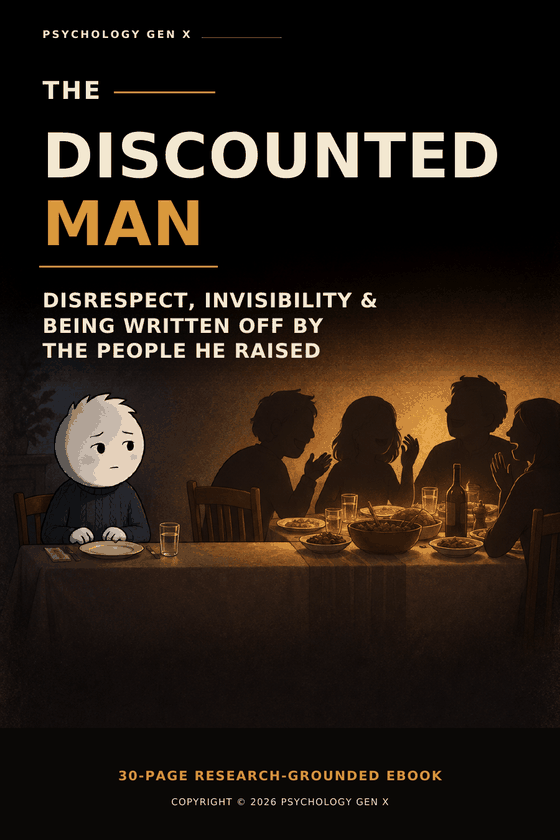
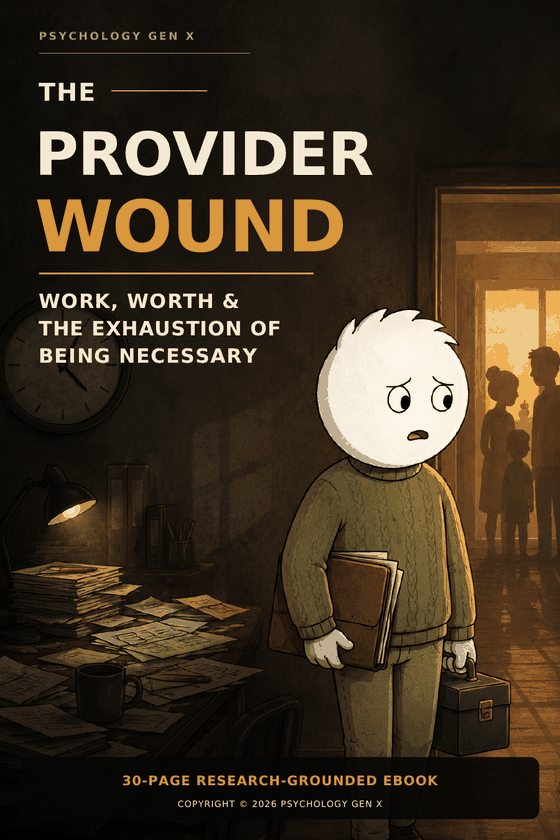
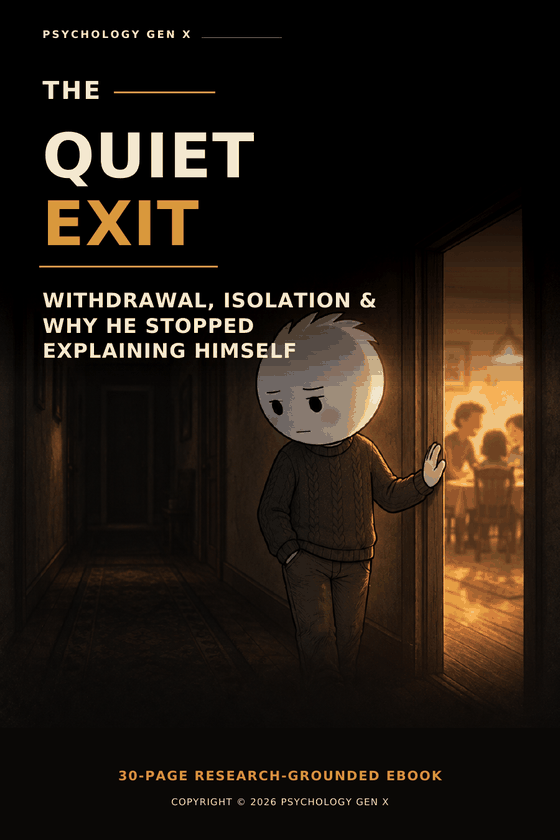
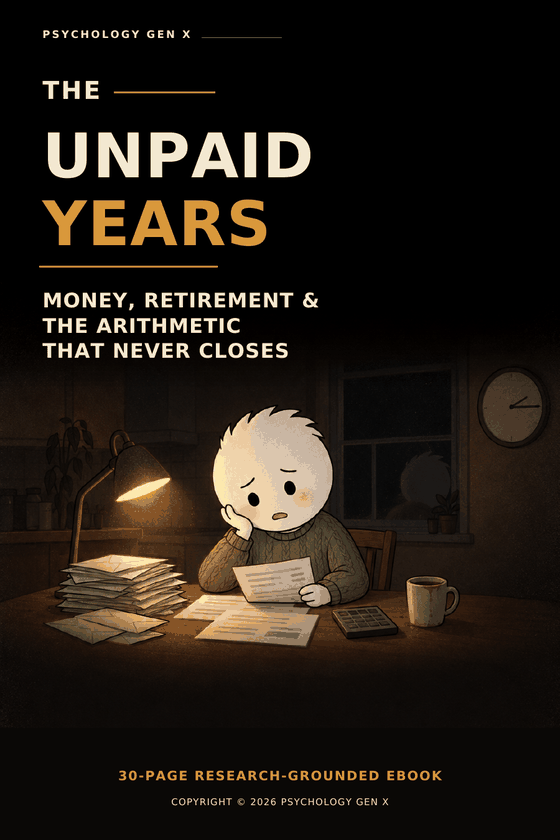
The Provider Wound ebook cover The Quiet Exit ebook cover The Unpaid Years ebook cover The Discounted Man ebook cover

Read Chapter One first. It is free.

Not an excerpt and not a summary — the whole of Chapter One of The Quiet Exit, exactly as it appears in the book, plus the introduction. Eight pages. Judge the writing before you spend anything.

Send me Chapter One
120 pagesFour 30-page prose ebooks, not worksheets
60+ sourcesEvery chapter traced to published research
$3.74 a bookIn the four-book set. Under six dollars each on their own.
The problem

Everything written about you was written by someone who wasn't there.

If you are a man over forty-five, you have almost certainly been handed one of these explanations for your own life:

Every one of those describes the surface accurately. Not one of them explains how the behaviour became useful, what it once protected, or what it is costing now. That gap is what these four books are for.

The library

Four patterns. One system.

Each book is a flowing prose essay across eight chapters — written to be read, not filled in. Read one to understand a pattern. Read all four to see how they hold each other in place.

The Provider Wound
Book One

The Provider Wound

Work, worth, and the exhaustion of being necessary

What happens when usefulness becomes the safest way to earn love. Why a man can be proud of providing and still be hollowed out by being valued mostly for what he can carry — and why he cannot rest without feeling like he is stealing.

  • The moment usefulness quietly replaced being loved — and why he cannot name the day it happened
  • Why a man who fixes everything for everyone cannot accept a favour without immediately repaying it
  • Rest guilt: why sitting down on a Saturday costs him more than the work ever did
  • The reason his family can appreciate him for twenty years and still not know him
The Quiet Exit
Book Two

The Quiet Exit

Withdrawal, isolation, and why he stopped explaining himself

Withdrawal is read as a decline. It is far more often a decision. What happens to a man who spent thirty years learning that speaking changed nothing — and why the same instinct that saved him at work is now emptying his house.

  • The specific afternoon a man decides to stop explaining himself — and why nobody notices for two years
  • Why just open up is the worst possible instruction for him, in research terms rather than opinion
  • The childhood arrangement that taught a whole generation that distress handled alone inconveniences nobody
  • The one difference between silence that protects a marriage and silence that ends it
The Unpaid Years
Book Three

The Unpaid Years

Money, retirement, and the arithmetic that never closes

The calculation he runs at two in the morning that always comes out the same. Why a generation that followed every instruction ended up short — and what scarcity does to a man's thinking long before it shows up in his bank balance.

  • What the two-in-the-morning calculation is actually measuring — and why the answer is not money
  • The study that found money pressure costs a working mind the equivalent of a full night of lost sleep
  • Why the house he cannot bring himself to sell stopped being a monument and became a subscription
  • The largest asset on his balance sheet, the one he has been treating as free for thirty years
The Discounted Man
Book Four

The Discounted Man

Disrespect, invisibility, and being written off by the people he raised

The moment his own child corrected him in front of other people, and the week he spent thinking about it. Why positional respect collapsed inside one working lifetime, and what kind of authority is still available to a man nobody defers to any more.

  • The forty seconds at a dinner table that a father thinks about for a week afterwards
  • Why being disagreed with and being disrespected feel identical to a man whose authority was never questioned at home
  • The exact sentence that ends the argument about who was right — and why it costs him more than any other
  • Needed versus valued: the distinction he got wrong for thirty years, and what it cost him
Research backbone

Nothing here is invented.

Every claim in these books is traced to published work. Each book closes with its own reference page. A partial list of what the set draws on:

Maier & Seligman (2016) — Learned helplessness at fifty. Psychological Review.

McEwen (1998) — Protective and damaging effects of stress mediators. NEJM.

Holt-Lunstad et al. (2015) — Loneliness and isolation as mortality risk. Perspectives on Psych. Science.

Marmot et al. (1991) — Whitehall II. The Lancet.

Mani, Mullainathan, Shafir & Zhao (2013) — Poverty impedes cognitive function. Science.

Siegrist (1996) — Effort-reward imbalance. J. Occup. Health Psych.

Karasek (1979) — Job demands and decision latitude. ASQ.

Levy et al. (2002) — Self-perceptions of aging and longevity. JPSP.

Neumark, Burn & Button (2019) — Age discrimination in hiring. J. Political Economy.

Luescher & Pillemer (1998) — Intergenerational ambivalence. JMF.

Van Orden et al. (2010) — Perceived burdensomeness. Psychological Review.

Vaillant (2012) — Harvard Grant Study. Triumphs of Experience.

Case & Deaton (2015) — Rising midlife mortality. PNAS.

National Institute on Retirement Security (2023) — Gen X retirement outlook.

Pricing

One book explains a pattern. The set explains the system.

Single book

Start with the one that sounds like your life.

$5.97

per book

  • One 30-page prose ebook
  • Eight chapters, written as essays
  • Full reference page included
  • Instant PDF download
Choose a book
Best value

The complete set

All four books. The whole picture.

$23.88$14.97

$3.74 a book · you save $8.91

For comparison: one therapy session in the US runs $100–$200. A trade paperback this length runs $18–$28.

  • All four 30-page ebooks
  • 120 pages, 32 chapters total
  • 60+ published sources across the set
  • Instant PDF download, keep forever
  • Read in any order
Get all four — $14.97

Secure checkout. Card or PayPal. Delivered by email the moment you pay.

Honest fit

Who this is for, and who it isn't.

Read this if

  • You are a man over forty-five and something in your life stopped adding up.
  • You want the mechanism, not motivation. No affirmations, no hustle.
  • You would rather read a serious essay than fill in a workbook.
  • You want to understand a father, a husband, or a brother who has gone quiet.

Skip this if

  • You want a step-by-step financial plan. This is psychology, not advice.
  • You want reassurance that none of it was your responsibility. The books do not say that.
  • You are in crisis right now. Please contact a professional first.
  • You want a quick fix. These describe patterns built across decades.
Straight answers

The questions you are actually asking.

Not the convenient ones. These are in the order people actually think them.

Is this AI filler dressed up to look like a book?

You should ask that about anything sold online now, and most pages will just tell you it isn't. Here is the answer that can be checked instead.

Every chapter names the research it rests on. Marmot and colleagues, 1991, in The Lancet. Holt-Lunstad and colleagues, 2015, in Perspectives on Psychological Science. Mani, Mullainathan, Shafir and Zhao, 2013, in Science. Author, year, journal, volume, pages. Between eleven and twenty-three sources per book, printed at the back.

Look up any one of them and check whether the finding is described correctly. Filler does not survive that test. That is why almost nothing at this price offers it.

Is this going to talk down to me?

No. There is a specific tone these books refuse.

They do not diagnose you. They do not describe you as broken. They do not treat a coping strategy that kept you employed and kept a household running for thirty years as a personal defect. The argument throughout is that the behaviour made sense where it was formed — and then it asks, without flinching, what it is costing now.

Explanation without excuse. If a pattern causes harm, the harm still matters.

Am I going to be told to journal and open up?

No affirmations. No morning routine. No breathing exercises. No gratitude list. No one under forty explaining your own life to you.

Where the books do suggest a change, it is small enough to perform on a bad day and specific enough to check afterwards: one sentence said out loud, one appointment kept, one conversation that comes back when it said it would. Nothing that requires you to become a different man.

Is this a funnel into something expensive?

No. There is no course, no coaching, no membership, no community, no webinar, and no upsell after checkout.

You buy the files, you download them, and that is the whole transaction. Nobody is going to call you.

I am buying this for my husband, or my father. Will he be offended?

These books were written to explain a man, not to correct one. They lead with why the behaviour made sense before they discuss what it costs, which is the opposite order from most things written about men his age.

That said, they are direct about impact and they do not excuse harm. If you are unsure, read it yourself first. Plenty of people do.

Will anyone know I bought this?

The charge appears as Gumroad, not as a book title. The files download straight to your device. There is no package, no envelope, no shipping notification, and nothing arrives at your house.

Read it alone. Nobody has to know.

What exactly do I get?

A PDF for each book you buy. Thirty pages, eight chapters written as flowing essays rather than worksheets, plus a reference page at the back. Roughly 4,700 words per book.

It arrives by email the moment you pay. Read it on a phone, a tablet, an e-reader, or print it. It is yours to keep.

Do I have to read them in order?

No. Each book stands alone. They do interlock — the silence in one is funded by the money problem in another — but you can start anywhere. Most people start with the title that sounds most like their own life.

Is this therapy?

No. These are educational ebooks. They explain patterns using published psychology and public-health research. They are not therapy, diagnosis, medical advice, or financial advice, and they are not a substitute for professional support. If you are struggling right now, please speak to a professional.

What if it is not for me?

Reply to your receipt email within 30 days and you get your money back. No form, no explanation required, no questions asked.
Last word

Understanding it does not fix it. It does stop you walking in circles.

A map does not excuse the terrain. But a man who can see the terrain accurately stops spending what is left of his energy on the part that was never his fault.

Get all four — $14.97

Instant download · 120 pages · 30-day refund, no questions